
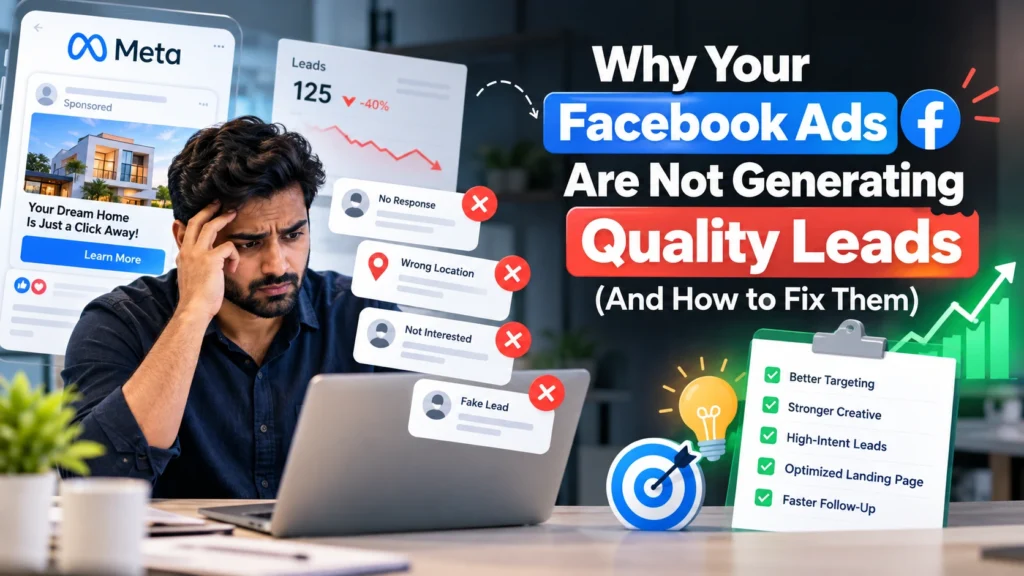
Are your Facebook Ads generating enquiries, but very few of those enquiries turn into genuine customers? You may be receiving incomplete forms, calls that go unanswered, people who are not interested in buying, or prospects who cannot afford your offer.
Facebook Ads may be generating leads without generating business opportunities because your campaign is optimised for the wrong outcome, your offer attracts low-intent prospects, or your follow-up process is not converting enquiries into sales.
The solution is not always to increase your advertising budget or change your audience. You need to identify where potential customers are dropping out of your marketing funnel and fix the actual problem.
In this guide, we explain why Facebook and Instagram Ads generate poor-quality leads, how to diagnose common campaign problems, and what businesses can do to improve lead quality and sales opportunities.
What Are Quality Leads in Facebook Ads?
A quality lead is a person or business that matches your target customer profile, shows genuine interest in your offer, and has a realistic chance of becoming a paying customer.
A lead can be considered qualified when it meets the criteria that matter to your business, such as:
- Relevant need: The prospect is interested in the product or service you offer.
- Suitable budget: The prospect can reasonably afford your offer.
- Correct location: The prospect is within your service area or target market.
- Buying intent: The prospect is considering a purchase, appointment, consultation or other meaningful next step.
- Reachability: The contact information is valid and the person can be contacted.
The exact definition depends on your business model. A qualified lead for a real estate company may be someone with a suitable property budget and purchase timeline. For a digital marketing agency, it may be a business owner who needs advertising support and has a realistic marketing budget.
The goal is not simply to generate more leads. It is to generate more relevant opportunities that your sales team can convert into customers.
1. Your Campaign Is Optimised for the Wrong Outcome
One of the first things to check is what you are asking Meta to optimise for.
If your objective is traffic, Meta generally looks for people likely to click. If your objective is lead generation, the campaign can optimise towards people likely to complete the selected lead action. These behaviours are not necessarily the same as purchasing a product or hiring a service.
For example, someone may click an advertisement because the creative looks interesting without having any intention of buying.
How to fix it
- Choose a campaign objective that matches your actual business goal.
- Use a suitable lead conversion location, such as an instant form, website form or messaging destination.
- Make sure the conversion event accurately represents the action you want users to complete.
- Where your tracking setup and campaign volume support it, evaluate deeper funnel outcomes rather than relying only on form submissions.
- Review qualified leads and sales outcomes alongside the results reported in Meta Ads Manager.
Practical tip: A campaign that generates fewer but more relevant enquiries may be more valuable than a campaign producing a large volume of unqualified leads.
2. Your Ad Creative Attracts Curiosity Instead of Buyers
Your advertisement influences who responds to your offer.
If your creative promises something vague, focuses only on a discount, or attracts people looking for free information, you may receive enquiries from users who were never a good fit.
For example, an advertisement saying “Get More Customers Today!” does not explain the service, target customer, requirements or next step.
A more specific message helps potential customers understand what you offer before they enquire.
How to fix it
Build your creative around four elements:
- Target audience: Make it clear who the offer is for.
- Specific problem: Describe a genuine challenge your audience faces.
- Relevant solution: Explain how your service addresses that problem.
- Clear next step: Tell the user what happens after submitting an enquiry.
For example, a digital marketing agency could use a message such as:
“Getting enquiries from Facebook Ads but struggling to turn them into customers? Let’s review your targeting, landing page and follow-up process to identify where potential leads are dropping off.”
This message is more specific than a generic promise of more leads. It also sets a clearer expectation about the service being offered.
Test different creative concepts, headlines and calls to action. Evaluate each variant by qualified leads and sales outcomes, not just clicks or engagement.
3. Your Audience Targeting Is Too Broad or Misaligned
Broad targeting is not automatically bad. Meta’s delivery system can find relevant prospects beyond the interests you initially expect. The problem occurs when the campaign brief, offer, geography or conversion signals do not align with your actual customer.
For example, a local service business may receive enquiries from outside its service area. A B2B company may attract individual consumers rather than business decision-makers. A premium service may attract users whose budgets do not match its pricing.
How to fix it
Start by reviewing the leads you have already received.
- Identify the locations and customer types generating relevant enquiries.
- Compare qualified and unqualified leads by campaign, ad set and creative.
- Check whether your service area and eligibility requirements are communicated clearly.
- Use audience exclusions or targeting restrictions where they are appropriate and permitted.
- Test broader targeting against more specific audience approaches when the budget allows a meaningful comparison.
Do not narrow audiences simply because the campaign is receiving poor leads. First determine whether the problem comes from targeting, the offer, the creative, the form or the sales process.
4. Your Offer Does Not Give People a Strong Reason to Enquire
Even well-targeted advertisements can perform poorly when the offer does not match what potential customers need.
An advertisement may explain your services without giving the user a compelling reason to take the next step. Alternatively, an offer may be attractive but too vague about the value the prospect will receive.
How to fix it
Make the offer specific, relevant and easy to understand.
Depending on your industry, you could offer:
- A preliminary consultation.
- A product demonstration.
- A project estimate.
- A property information pack.
- A service suitability assessment.
- A review of an existing marketing campaign.
Explain what the user will receive, who the offer is suitable for, and what information is required.
Avoid exaggerated claims or guaranteed outcomes that you cannot substantiate. Trust and clear expectations can help filter out prospects who are unlikely to proceed.
5. Your Lead Form Is Too Easy or Too Difficult to Complete
Lead forms influence both conversion volume and the information you collect.
A short form can reduce friction, but it may also encourage submissions from people who have not considered the offer carefully. A long form can collect more information, but it may discourage genuinely interested prospects.
Neither a short form nor a long form is automatically better.
How to fix it
Choose your form based on the complexity and value of your offer.
For straightforward enquiries, collect only the information required to initiate contact.
For higher-consideration services, consider asking a small number of qualification questions, such as:
- What service are you interested in?
- What is your approximate budget?
- When are you planning to proceed?
- Which city or service area are you located in?
Use relevant questions rather than collecting information simply because it is available.
Where suitable, test Meta’s higher-intent instant form options against a simpler form. For website lead generation, compare the completion rate and quality of enquiries from your landing page.
Measure both the number of completed forms and the proportion of leads that qualify. The right balance depends on your offer, audience and sales process.
6. Your Landing Page Does Not Build Enough Trust
When users click an advertisement and arrive on your website, they should immediately understand what you offer and why it is relevant to them.
A mismatch between the ad and landing page can cause users to leave without enquiring.
Common problems include:
- A headline that does not match the advertisement.
- Unclear service descriptions or pricing expectations.
- Slow loading or poor mobile usability.
- Missing business contact details.
- Weak evidence of experience or credibility.
- A confusing form or call to action.
- Unnecessary steps before submitting an enquiry.
How to fix it
Create a landing page that continues the message from your advertisement.
Use a clear headline, explain the service and its benefits, provide relevant proof, answer common objections and make the next step obvious.
Include genuine testimonials, case studies or project examples where available and permitted. Do not invent client results, reviews or performance figures.
Test the page on mobile devices, check form functionality, and confirm that conversion tracking works correctly.
For businesses with more complex services, a dedicated landing page may perform better than sending every visitor to a generic homepage. Test this against your actual campaign data rather than assuming one format always wins.
7. Your Sales Team Is Not Following Up Quickly or Consistently
Not every lead that fails to convert is a poor-quality lead.
Someone may have submitted a genuine enquiry but become unavailable, forget the details, or choose another provider because nobody contacted them promptly.
This is why lead quality should be assessed alongside the lead-handling process.
How to fix it
Create a clear follow-up process for every new enquiry.
- Send an acknowledgement confirming that the enquiry was received.
- Assign the lead to a responsible team member.
- Attempt contact promptly during appropriate business hours.
- Record whether the lead answered, qualified, booked a meeting or declined.
- Schedule a relevant follow-up when the prospect has not responded.
- Update the CRM with the lead’s latest status.
WhatsApp, phone calls, email and CRM automation can help streamline the process, depending on the customer’s preferences and applicable consent requirements.
Track the time between lead submission and the first contact attempt. If leads are contacted hours or days after submitting a form, investigate this before rebuilding the advertising campaign.
8. You Are Measuring Cost Per Lead Instead of Cost Per Qualified Lead
Cost per lead (CPL) tells you how much you spend to acquire a lead. It does not tell you whether that lead is relevant, sales-ready or profitable.
Consider this illustrative example.
| Metric | Campaign A | Campaign B |
|---|---|---|
| Advertising spend | ₹20,000 | ₹20,000 |
| Leads generated | 200 | 80 |
| Cost per lead | ₹100 | ₹250 |
| Qualified leads | 10 | 24 |
| Cost per qualified lead | ₹2,000 | About ₹833 |
In this example, Campaign A generates more leads at a lower CPL. However, Campaign B generates more qualified leads from the same advertising spend.
The figures are hypothetical and are intended to demonstrate the calculation, not represent an industry benchmark.
How to fix it
Track the complete path from advertising spend to revenue.
Useful metrics include:
- Cost per lead: Advertising spend divided by leads generated.
- Lead qualification rate: Qualified leads divided by total leads.
- Cost per qualified lead: Advertising spend divided by qualified leads.
- Lead-to-customer conversion rate: Customers acquired divided by leads generated.
- Customer acquisition cost: Total attributable acquisition costs divided by customers acquired.
Where possible, compare performance by campaign and creative, while allowing for conversion delays and sufficient data.
This approach helps you determine whether to improve the ad, the form, the landing page, the sales process or the overall offer.
9. Your Tracking and CRM Are Not Connected Properly
If your reporting stops when someone submits a form, you may not know which campaigns are producing meaningful business results.
A CRM can help you record what happens after a lead enters your system. Depending on your setup, conversion tracking and approved data integrations can also help return useful downstream signals to advertising platforms.
How to fix it
Review the following:
- Install and verify the Meta Pixel where applicable.
- Consider the Conversions API where it fits your website, CRM and technical setup.
- Ensure lead events are recorded correctly and avoid duplicate event counting.
- Use UTM parameters to identify campaign, ad set and creative sources.
- Record lead status, qualification outcome and customer conversion in your CRM.
- Where supported, use appropriate CRM or Conversions API integrations to share relevant conversion outcomes with Meta.
Configure tracking in line with consent requirements, applicable privacy rules and Meta’s policies. Do not send unnecessary sensitive information.
A technically correct tracking setup will not automatically improve lead quality. Its value is that it makes performance easier to diagnose and can provide better feedback for optimisation when the necessary data and integrations are available.
10. You Keep Changing Campaigns Without Identifying the Real Problem
Frequent changes to budgets, audiences, creatives and campaign settings can make it difficult to determine what actually improves results.
If a campaign performs poorly, changing every element at once may produce a different result without revealing why.
How to fix it
Use a structured testing process.
Step 1: Establish a baseline. Record spend, leads, qualified leads, CPL and conversion outcomes.
Step 2: Identify the largest problem. For example, determine whether the issue is poor lead relevance, low form completion, or failure to contact prospects.
Step 3: Test one meaningful change. Depending on the diagnosis, test a different offer, creative, form, landing page or follow-up process.
Step 4: Allow sufficient data to accumulate. Avoid drawing conclusions from a handful of conversions or making changes before the results can be evaluated meaningfully.
Step 5: Compare business outcomes. Evaluate qualified leads and sales progression, not only the platform’s reported lead count.
This process gives you a clearer basis for deciding what to improve next.
How to Diagnose Poor-Quality Facebook Leads
Before increasing your budget or rebuilding your campaign, use this checklist to identify where the problem occurs.
| What you observe | What to investigate first |
|---|---|
| Many clicks but few leads | Offer, landing page, page speed and conversion tracking |
| Many leads but invalid contact details | Form design, data quality and submission patterns |
| Leads are outside your target market | Geography, eligibility and message clarity |
| Prospects enquire but cannot afford the service | Offer positioning, pricing expectations and qualification questions |
| Genuine leads do not answer calls | Follow-up timing, contact details and contact process |
| Leads are relevant but few become customers | Sales process, offer fit, pricing, objections and follow-up |
| Low CPL but poor sales outcomes | Cost per qualified lead and lead-to-customer conversion |
These are diagnostic starting points rather than definitive explanations. Review the actual lead records and campaign data before making major changes.
Frequently Asked Questions
Why are my Facebook Ads generating low-quality leads?
Common causes include a mismatch between the campaign objective and business goal, unclear ad messaging, an unsuitable offer, insufficient qualification, and inconsistent sales follow-up. The right solution depends on where prospects are dropping out of your funnel.
How can I improve lead quality in Meta Ads?
Clarify your offer, align the campaign with the desired conversion, test suitable qualification questions, improve your landing page, and track qualified leads rather than relying only on CPL. Use your CRM to understand which campaigns produce genuine sales opportunities.
Are Facebook instant forms bad for lead generation?
No. Instant forms can reduce friction and make it easier for people to enquire. However, a low-friction form may also produce casual submissions. Test the available form types, qualification questions and downstream lead quality for your particular offer.
Should I increase my Facebook Ads budget to get better leads?
Not necessarily. Increasing spend before identifying the cause of poor-quality leads may simply increase the number of unqualified enquiries. First investigate targeting, offer relevance, form quality, conversion tracking and follow-up.
What is more important: low cost per lead or high lead quality?
Both matter, but neither should be evaluated in isolation. A low CPL is useful only when the leads have a reasonable chance of becoming customers at an acceptable acquisition cost. Track qualified lead cost, customer conversion rate and profitability alongside CPL.
When should I hire a Meta Ads agency?
Consider hiring an agency when you need specialist campaign management, conversion tracking, creative testing, landing-page optimisation or a more systematic lead-generation process. Before choosing a provider, review its relevant experience, reporting approach, service scope and genuine case studies.
Final Thoughts
If your Facebook Ads are generating enquiries but not enough genuine business opportunities, the answer is not always to spend more or change your audience.
Start by examining the entire lead-generation process: campaign objective, creative, offer, audience, form, landing page, tracking and sales follow-up.
Measure how many leads qualify, how many become customers and what each acquisition costs. These figures will help you make more informed decisions about where your marketing budget should go.
Need help identifying why your Meta Ads are not generating quality leads?
Paa Creations helps businesses approach digital marketing through paid advertising, lead generation, landing pages, conversion tracking and automation. If you are struggling to turn ad spend into relevant enquiries, contact Paa Creations to discuss your current campaigns and identify which parts of your lead-generation process may need improvement.
The objective is not simply to generate more leads. It is to build a more measurable process for attracting the right prospects and converting them into customers.
